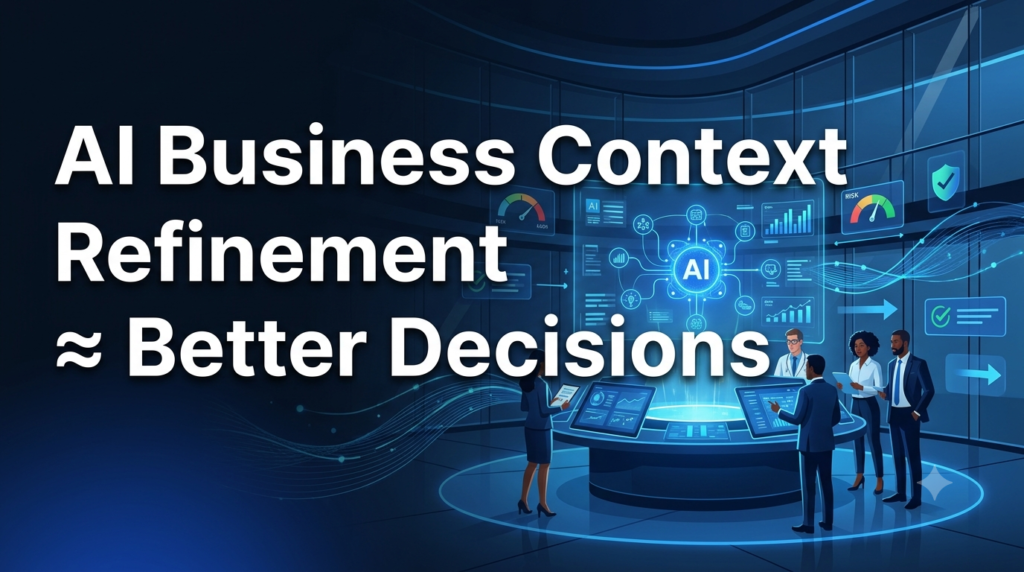

AI Business Context Refinement: A Complete Guide for Smarter Enterprise AI
Artificial intelligence has become a core part of modern business operations. Companies use AI to automate workflows, assist employees, improve customer service, analyze data, and accelerate decision-making. Yet despite rapid advances in large language models (LLMs), many organizations discover that generic AI responses often fall short of business expectations.
The missing ingredient is context.
An AI model may know millions of facts about the world, but it knows nothing about your company’s internal processes, products, customers, terminology, or strategic priorities unless that information is deliberately provided. This is where AI business context refinement becomes essential.
Rather than relying solely on the model’s general knowledge, business context refinement continuously enriches AI with organization-specific information so it can produce responses that are accurate, relevant, and aligned with business goals.
In this guide, you’ll learn what AI business context refinement is, why it matters, how it works, implementation best practices, real-world use cases, and how organizations can use it to maximize the value of enterprise AI.
What Is AI Business Context Refinement?
AI business context refinement is the process of supplying artificial intelligence systems with relevant business knowledge before they generate responses or make recommendations.
Instead of asking an AI model to answer questions based only on its pre-trained knowledge, organizations provide additional information such as:
- Company documentation
- Internal policies
- Product catalogs
- Customer records
- Business workflows
- Standard operating procedures
- Industry regulations
- Historical interactions
- Live operational data
This refined context allows AI to produce answers that are tailored to the organization’s environment rather than generic responses.
For enterprise AI, context often matters more than model size. Even the most powerful language model can produce inaccurate or incomplete answers if it lacks access to the right business information.
Why Business Context Is the Missing Piece of Enterprise AI
Many organizations invest heavily in AI but see inconsistent results.
For example, imagine two customer support agents using the same AI assistant.
The first asks:
Without business context, the AI might generate a generic explanation of warranty policies.
With business context refinement, the AI can instead retrieve:
- The company’s warranty policy
- Customer purchase history
- Regional regulations
- Product eligibility
- Internal approval workflows
- Required documentation
The difference is significant. Rather than acting like a search engine, the AI functions as an intelligent business assistant.
How AI Business Context Refinement Works
Business context refinement follows a structured process that combines data management, retrieval systems, and large language models.
Collect Business Knowledge
The first step is identifying the information employees and AI systems need most frequently. Common sources include:
- CRM platforms
- ERP systems
- Internal documentation
- Product manuals
- Knowledge bases
- Help center articles
- Support tickets
- Meeting notes
- Company wikis
- Compliance documents
The objective is to centralize valuable organizational knowledge.
Organize and Structure Data
Raw information is rarely useful in its original form. Organizations typically organize content into categories such as:
- Sales: Pricing, proposals, contracts, customer accounts
- Marketing: Brand guidelines, campaign documentation, buyer personas
- Operations: SOPs, logistics, inventory processes
- Human Resources: Employee handbook, leave policies, benefits
- Finance: Budget procedures, expense policies, financial reporting
Well-structured information makes context retrieval much more effective.
Retrieve Relevant Context
One of the biggest mistakes in enterprise AI is providing too much information. Instead of loading every document into a prompt, modern systems retrieve only the information relevant to the user’s question.
For example:
Question: “How do we onboard a new enterprise customer?”
The AI retrieves: Enterprise onboarding guide, security checklist, customer success workflow, product setup documentation
This targeted retrieval improves accuracy while reducing unnecessary complexity.
Enrich the AI Prompt
Retrieved business information is combined with the user’s request. Instead of receiving only “Generate a customer response,” the AI receives:
- Customer profile
- Previous support history
- Company policies
- Product documentation
- Business rules
- User request
The enriched prompt enables significantly more useful responses.
Generate Business-Aware Responses
The AI combines its language capabilities with retrieved business knowledge to produce recommendations that align with company objectives. This process improves accuracy, personalization, consistency, and decision quality.
Benefits of AI Business Context Refinement
Organizations implementing context refinement often experience measurable improvements across multiple business functions.
More Accurate AI Responses
AI no longer relies entirely on general knowledge. Instead, responses reflect current business information.
Reduced Hallucinations
One of the biggest challenges with generative AI is hallucination. Providing verified business context significantly reduces this risk.
Faster Employee Productivity
Employees spend less time searching through documentation. AI retrieves the relevant information immediately.
Better Customer Experience
Customer support teams can provide faster, more personalized responses based on customer history and company policies.
Stronger Decision-Making
Executives receive recommendations grounded in organizational data rather than generic assumptions.
Improved Compliance
Industries such as healthcare and finance benefit from AI systems that incorporate regulatory requirements into every response.
Technologies Behind Context Refinement
Several technologies work together to make business context refinement possible.
Large Language Models (LLMs)
LLMs generate natural language responses based on provided context. Examples include GPT-based models, Claude, Gemini, and Llama.
Retrieval-Augmented Generation (RAG)
Rather than storing all business knowledge inside the model, RAG retrieves relevant information from external sources before generating an answer.
Vector Databases
Documents are converted into numerical representations called embeddings. Vector databases enable semantic search, allowing AI to retrieve information based on meaning.
Knowledge Graphs
Knowledge graphs map relationships between products, customers, employees, and business processes, providing structured context that improves reasoning.
Semantic Search
Instead of matching words literally, semantic search understands intent, retrieving documents about “returns” even if searching for “refund.”
Real-World Business Applications
AI business context refinement can be applied across nearly every department.
Customer Support
- Customer history
- Product manuals
- Warranty information
- Support documentation
Sales
- Account summaries
- Proposal generation
- Upsell recommendations
- Customer engagement analysis
Marketing
- Brand voice alignment
- Campaign goals
- Target audience data
- Existing messaging
Human Resources
- Benefits information
- Leave policies
- Internal procedures
- Training resources
Finance
- Expense classification
- Financial reporting
- Budget analysis
- Policy guidance
Healthcare
- Clinical guidelines
- Patient history
- Treatment protocols
- Administrative documentation
Best Practices for Successful Implementation
Organizations should follow several principles when implementing AI business context refinement.
Keep Business Data Current
Outdated documentation leads to outdated AI responses. Regularly review and update knowledge sources.
Prioritize Data Quality
AI cannot compensate for inconsistent or inaccurate information. Clean, structured data produces better outcomes.
Apply Role-Based Permissions
Employees should only access information appropriate for their role. Sensitive documents require strict access controls.
Measure Performance
Monitor metrics such as response accuracy, employee satisfaction, customer satisfaction, time saved, and workflow completion rates.
Refine Context Continuously
Business processes evolve. AI context should evolve alongside them through ongoing updates and feedback.
Common Challenges
While context refinement delivers substantial benefits, implementation requires careful planning.
Information Silos
Knowledge often exists across disconnected systems. Integration is essential.
Too Much Context
Providing excessive information can reduce response quality. Retrieving only the most relevant content is more effective.
Security and Privacy
Organizations must protect sensitive customer and employee information. Access controls and governance policies are critical.
Change Management
Employees need training to use AI effectively. Technology adoption depends on people as much as software.
The Future of AI Business Context Refinement
As enterprise AI matures, business context will become a competitive advantage. Emerging trends include:
- Real-time context retrieval from operational systems
- Personalized AI assistants for every employee
- Autonomous AI agents that collaborate across departments
- Context-aware decision support systems
- Multimodal AI combining documents, images, video, and structured data
Organizations that invest in high-quality business knowledge today will be better positioned to take advantage of these developments.
Frequently Asked Questions
AI business context refinement is the practice of enriching AI systems with organization-specific knowledge so they generate more accurate, relevant, and business-aware responses.
Without business context, AI produces generic answers. Context enables AI to understand company policies, workflows, terminology, and objectives.
Prompt engineering focuses on how questions are asked. Context refinement focuses on providing the AI with the right business information before it answers.
Any organization using AI with internal knowledge, customer data, or business-specific processes can benefit from context refinement.
Healthcare, finance, legal services, manufacturing, retail, customer support, software development, and enterprise SaaS organizations are among the industries that gain the greatest value.
Conclusion
The success of enterprise AI depends on more than selecting the most advanced language model. The real differentiator is the quality of the business knowledge that surrounds it.
AI business context refinement transforms generic AI into an intelligent business partner by connecting language models with company-specific information, workflows, and objectives. Whether supporting employees, assisting customers, or improving executive decision-making, context-aware AI delivers more accurate, reliable, and actionable results.
As organizations continue investing in artificial intelligence, those that prioritize context refinement will be better equipped to scale automation, improve productivity, and build AI systems that truly understand their business.