
AI Business Context Refinement: Complete Guide for Business Leaders (2026)
Artificial Intelligence has evolved from simple automation into intelligent systems capable of understanding business processes, customer needs, operational workflows, and strategic objectives. However, even the most advanced AI models cannot consistently deliver valuable results without understanding the specific context of the organization.
This is where AI Business Context Refinement becomes essential.
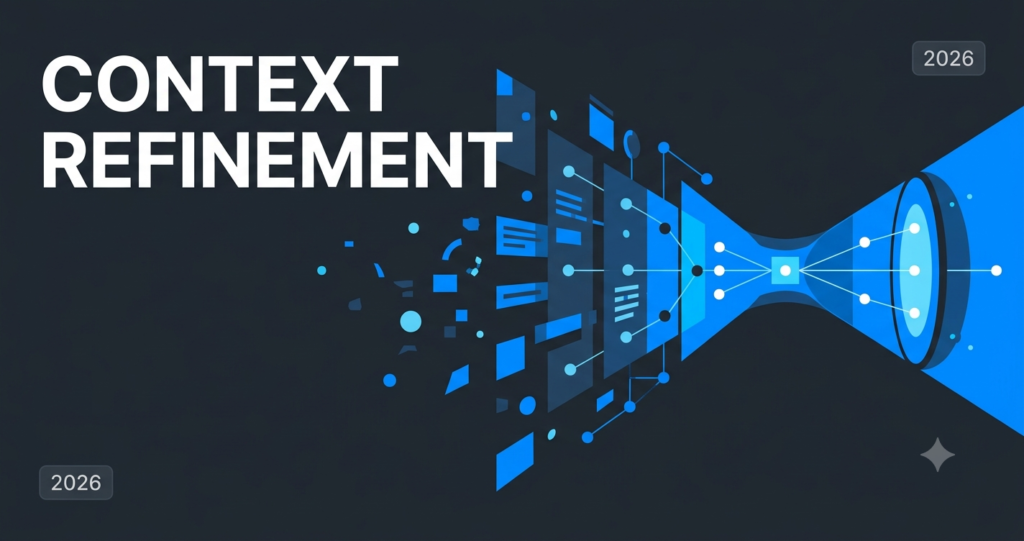
Rather than relying solely on generic knowledge, context refinement enables AI systems to incorporate company-specific information, business rules, historical decisions, customer behavior, industry terminology, and organizational goals before generating responses or recommendations.
Key Insight
Organizations implementing context refinement report more relevant outputs, improved decision-making, greater automation efficiency, and stronger employee adoption of AI tools.
This guide explains everything business leaders need to know about AI Business Context Refinement, including its benefits, architecture, implementation strategies, challenges, and future trends.
What Is AI Business Context Refinement?
AI Business Context Refinement is the process of continuously improving the information, knowledge, and situational awareness provided to an AI system so it can generate responses that align with a company’s objectives, policies, workflows, and industry requirements.
Instead of asking AI to answer using only its general knowledge, organizations enrich every request with relevant business context such as:
- Company documentation
- Internal procedures
- Customer information
- Product catalogs
- Historical interactions
- Business rules
- Compliance requirements
- Department-specific knowledge
- Real-time operational data
The result is AI that understands not only language but also the business environment in which it operates.
Why Business Context Matters
Without business context, AI often produces responses that are technically correct but operationally unusable.
Real Example
Without Context: A generic AI may recommend increasing inventory without understanding warehouse capacity.
With Context: A context-aware AI understands current stock levels, supply chain delays, seasonal demand, budget constraints, storage limitations, and sales forecasts.
This additional context transforms AI from a general assistant into a business advisor.
How AI Business Context Refinement Works
The refinement process typically follows several stages:
Relevant business information is gathered from multiple sources including CRM systems, ERP platforms, knowledge bases, internal documentation, emails, product databases, financial reports, customer support tickets, and meeting notes.
Collected information is categorized according to business domains such as Marketing, Sales, Human Resources, Finance, and Operations.
Not every piece of information is relevant for every request. Modern AI systems identify only the information necessary for answering a specific query.
The selected context is added before the user’s question, providing AI with comprehensive business background.
Using enriched context, AI produces recommendations aligned with business objectives and organizational knowledge.
Organizations monitor response quality, user feedback, accuracy, and business impact. The context is continuously updated as the business evolves.
Benefits of AI Business Context Refinement
Better Decision Making
Executives receive recommendations based on company realities rather than generic assumptions.
Improved Customer Experience
AI understands customer history, preferences, and previous interactions, leading to more personalized support.
Increased Productivity
Employees spend less time searching documentation. AI retrieves relevant information instantly.
More Accurate Responses
Context significantly reduces hallucinations, generic answers, incorrect recommendations, and missing information.
Stronger Compliance
Industries like healthcare and banking require AI to follow strict regulations. Context refinement ensures compliance.
Higher ROI on AI
Organizations maximize the value of existing data instead of purchasing larger AI models.
Key Components of Context Refinement
Successful AI Business Context Refinement depends on several critical components:
- Knowledge Management: Centralized documentation and organized information
- Data Integration: Connection with business applications and systems
- Semantic Search: Finding relevant information rather than exact keywords
- Vector Databases: Efficient storage of document embeddings
- Retrieval-Augmented Generation (RAG): Fetching relevant business information before generating responses
- Business Rules Engine: Applying organizational policies automatically
- User Personalization: Adapting responses according to user roles and permissions
Common Business Use Cases
Customer Support
AI answers questions using documentation, customer records, and product manuals to provide accurate, personalized support.
Sales Assistance
AI recommends upselling opportunities, pricing strategies, and customer-specific offers based on company data.
Marketing
AI generates personalized campaigns, performs audience segmentation, and develops content strategies aligned with brand guidelines.
Human Resources
Employees ask questions about leave policies, payroll, benefits, and internal procedures with instant, accurate answers.
Healthcare
AI assists physicians using clinical guidelines, patient history, and medical documentation for better clinical decisions.
Manufacturing
AI monitors production schedules, equipment status, inventory, and maintenance records for operational optimization.
Best Practices for Implementation
1. Maintain High-Quality Data
Poor data leads to poor AI decisions. Regularly update documents, policies, and knowledge bases to ensure accuracy and relevance.
2. Remove Duplicate Information
Conflicting documentation confuses AI systems. Maintain a single source of truth for critical information.
3. Define Clear Business Rules
Business policies should be explicit rather than implied. Document organizational standards clearly.
4. Implement Role-Based Access
Employees should only receive information they are authorized to access. Respect security and compliance requirements.
5. Monitor Performance Metrics
Track accuracy, user satisfaction, response time, cost savings, and automation rates to measure success.
6. Update Context Frequently
Business knowledge changes continuously. Old documentation reduces AI reliability and accuracy.
Technology Stack for Context Refinement
Several technologies contribute to effective AI Business Context Refinement:
| Technology | Function |
|---|---|
| Large Language Models (LLMs) | Core AI engine for understanding and generating text |
| Retrieval-Augmented Generation (RAG) | Framework for fetching relevant context before generation |
| Knowledge Graphs | Structured representation of business knowledge and relationships |
| Vector Databases | Efficient storage and retrieval of semantic embeddings |
| Semantic Search | Finding contextually relevant documents beyond keyword matching |
| Embedding Models | Converting text to numerical representations for comparison |
| Workflow Automation | Orchestrating multi-step processes with AI integration |
| API Integrations | Connecting AI to business systems and data sources |
Overcoming Implementation Challenges
Data Silos
Information often exists across disconnected systems. Solution: Implement unified data integration platforms that connect disparate sources.
Poor Documentation
Many organizations lack structured documentation. Solution: Invest in knowledge management systems and establish documentation standards.
Security & Privacy
Sensitive information requires access controls. Solution: Implement role-based access and encryption for protected data.
Scalability
As businesses grow, managing context becomes increasingly complex. Solution: Use cloud-based platforms designed for scale.
Context Overload
Providing excessive information may reduce AI performance. Solution: Implement intelligent selection algorithms to choose only relevant context.
Future Trends in AI Business Context
Adaptive Context
AI dynamically adjusts context during conversations, learning what information is most relevant for each user and situation.
Real-Time Business Intelligence
AI combines live dashboards with historical knowledge to provide current, actionable insights.
Autonomous AI Agents
Multiple AI agents collaborate while sharing contextual information to solve complex business problems.
Industry-Specific AI
Organizations develop specialized context tailored to healthcare, finance, manufacturing, legal, and other specialized domains.
Multimodal Context
AI integrates text, images, videos, audio, and structured data into a unified business context.
Frequently Asked Questions
It is the process of providing AI systems with relevant business information, policies, workflows, and organizational knowledge so they generate more accurate and business-specific responses.
Business context helps AI understand organizational goals, terminology, and constraints, leading to better decisions and more relevant recommendations that actually work in your business.
By supplying AI with current and relevant company information, context refinement reduces generic responses, minimizes hallucinations, and aligns outputs with business requirements.
No. Small and medium-sized businesses can also benefit by organizing internal knowledge and connecting AI tools to relevant business data. The principles are the same at any scale.
Organizations often combine Large Language Models (LLMs), Retrieval-Augmented Generation (RAG), vector databases, semantic search, knowledge graphs, and enterprise data integrations.
Conclusion
AI Business Context Refinement is becoming a foundational capability for organizations seeking to deploy AI effectively. While powerful language models provide broad knowledge, meaningful business value comes from combining those models with accurate, current, and organization-specific context.
By investing in structured data, knowledge management, secure integrations, and continuous refinement, businesses can:
- Improve decision-making
- Automate complex workflows
- Deliver better customer experiences
- Maximize return on AI investments
As enterprise AI continues to evolve, context refinement will remain a key differentiator between generic AI deployments and solutions that consistently produce reliable, actionable business outcomes.
Ready to Transform Your Business with AI Context Refinement?
Join leading organizations implementing intelligent context-aware AI systems for better decisions, faster automation, and superior customer experiences.